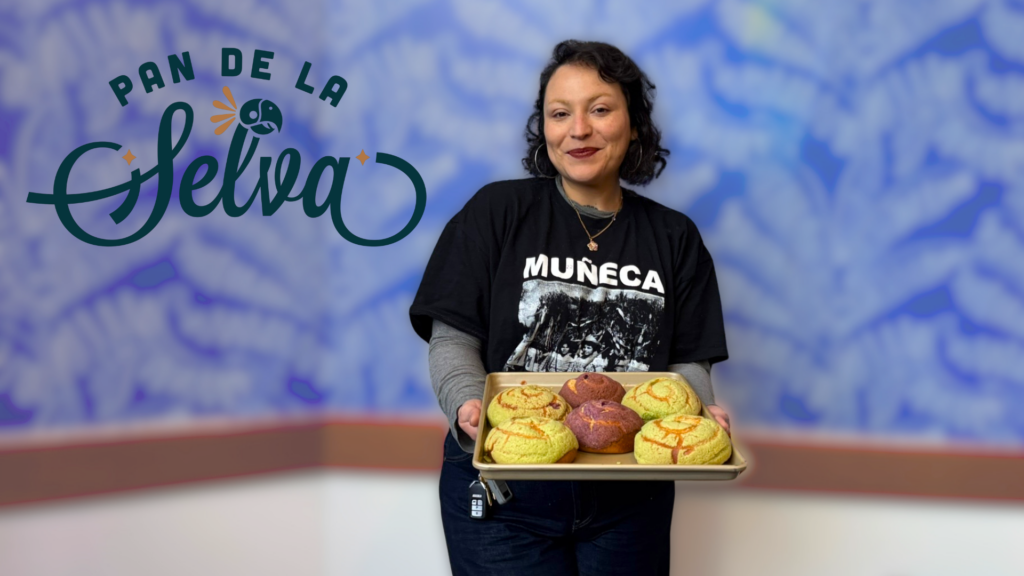
Mayra Sibrian, owner of Pan de La Selva, is doing something you might not exactly expect to find in Seattle’s City Hall: baking beautifully colorful, Latin American-inspired pan dulce and welcoming anyone who walks through the door into a world of flavors they may have never encountered before. We sat down with Mayra to talk about her bakery, her story, and why spending here really does matter.
Tell us about yourself and Pan de La Selva.
Hi, my name is Mayra Sibrian and I’m the owner of Pan de La Selva. We’re located in Seattle City Hall and we’ve been open since August of 2025.
What has the reception from the community been like?
For the most part, it’s been great. If anything, it’s been kind of exciting, just because this isn’t something that you would normally find or expect to discover in City Hall. And especially with how I’ve decorated the place, it’s very colorful and it’s such a big space. It’s always fun for me when people walk in and they’re like, “What is this place? What’s going on here?” So I think that’s very fun.
What are some of the products people can find when they come in?
My mother is from Mexico and my dad is from El Salvador, so I like to bake pan dulce inspired by the flavors of that culture. Right now we have an Earl Grey blueberry concha, a matcha pistachio, and a guava rhubarb semita, which is like a pie tart. And I say all these things, concha, semitas, and to some people they might sound so foreign, but at its core it’s like brioches, pound cakes, pie tarts. Very familiar items. There’s something for everyone.
We also have a roasted poblano and cashew cream puff pastry featuring loroco. It’s an edible flower, and I kind of describe it as asparagus in texture but more like a gnarly broccoli in flavor. A big part of why I blend Latin ingredients with local ingredients is to be inviting to people who may not be familiar with your typical pan dulce.
If someone’s coming in for the first time, what would you recommend?
That is such a tough question! I’m really happy to say that I feel like each item is someone’s favorite, which makes me really happy. I like to say you can’t go wrong. But the most classic item we have would be the concha. It’s a very popular Mexican-style bun, basically a brioche with a crumble topping. Normally you don’t see them filled, but we do fill them here, just because it’s another way to be fun and creative with flavors.
Another favorite of mine is actually the quesadilla, which always gets some fun reactions, because different countries have their own version. In El Salvador and Honduras, a quesadilla is actually a cheese pound cake made with ricotta, queso fresco, and cotija. Different families use different cheeses. It’s always fun for me when people are like, “Wait, where’s the flour tortilla and cheese?” But yeah, I would definitely suggest one of those.
How did this become your thing? What’s the story behind Pan de La Selva?
I always knew I wanted to be in food. It always interested me from a young age. I went to culinary school straight out of high school. I didn’t like it, I just didn’t like the environment. But at different stages of my life, being in this field, there have been different reasonings and purposes that motivated me to continue. Back then I just liked the idea of making something with my hands and then getting to eat it.
When I moved up here to Seattle, this was back around 2018, 2019, it was still kind of common in the media for people to put all of Latin America under the umbrella of Mexico. And I grew up with different styles of pan dulce, and I wanted to introduce that and show people that even though Mexico is the most well-known for pan dulce, other countries have their own style too. So I just wanted to represent that.
Little by little I started incorporating things that were important to me and that I found fun. And because people weren’t familiar with the product, I wanted to incorporate ingredients they would be familiar with. But using ingredients that are grown here is also another level of staying connected to what the land has to offer. Because even though there’s no selva, no jungle, here in Washington, the land is still fruitful and has captured the spirit of a jungle. It’s my way of staying connected to my family, to nature, to where I came from. And I just wanted to share that.
Can you talk about the name?
The name Pan de La Selva means “bread of the jungle.” It developed over time. Originally I wanted a creative outlet and started painting on glass, keeping with the jungle theme, staying connected to nature and where I came from. I came up with a name for that, but then food and baking were my first love, so I started focusing more on that.
I went through a couple of names. I tried Selva Central Goods when I started doing pop-ups and farmers markets, but it wasn’t really rolling off the tongue. People would just call it “Central Goods” or “Selva” and it got confusing. So I landed on Pan de La Selva, bread of the jungle. It just rolls off the tongue better, it’s easier to remember, and it’s more accurate to where my panadería is now.
Intentionalist’s motto is “spend like it matters.” What does that mean to you in the context of Pan de La Selva?
I feel like people who come here and spend their money here, they’re supporting representation. Not just Mexican culture, but Central American culture, Latin American culture. And it’s made by a small Latina-owned business.
The market is saturated with baked goods that we’re so familiar with seeing, very eurocentric pastries. And there’s people doing cool stuff, but pan dulce in itself has so many styles. We’re entering a time where there’s a first and second generation of Latinx bakers who are really tapping in and making it their own. It’s about sharing knowledge of where these ingredients come from, where the style of bread comes from. And the fact that it’s coming from us makes it authentic, even though the bread might not be “authentic” in the way your grandmother made it. Food travels through generations. The fact that it’s being made by me, a Latina, also makes it authentic because this is my version. Just how other bakers are presenting their cultural food, they’re passing down knowledge and representation. In a way, it’s preservation too.
I also feel like my prices are just as competitive as any other bakery in Seattle in 2026. But people come in and they’re like, “Oh my god, you’re charging this much for a concha?” And it’s like, you make it and tell me you wouldn’t charge as much. It’s incredibly labor intensive, especially with the ingredients I use. And there’s this narrative that Mexican food, Central American food, any food from a minority culture needs to be affordable or cheaper, and that’s just nonsense. Most often it is the most labor-intensive product people are putting out.
And honestly, not only do people not tend to question pricing when a man sets his prices versus when a woman does, but if you are purchasing food from someone white who is making Mexican food versus someone who is actually a part of that culture, people are more willing to pay for the food made by a white person. So that’s why it’s important to support businesses that are actually owned by the people whose culture the food belongs to. Not to say that someone outside the culture can’t also make that food, but what lens are they bringing? What knowledge and perspective are they sharing with you through that food?
And with the current climate, if you’re out here making Mexican or Central American food and you haven’t spoken out against what’s happening with ICE, then what are you doing? You just like our food and not our people. And that’s harmful, because those people and that food are so deeply intertwined.
How do you think about food more broadly?
Food is passing down culture, knowledge, and preservation.
Is there anything else you want people to know about Pan de La Selva?
I like to think about color, texture, and flavor in everything I make. I like for things to be balanced. I don’t like making my items super sweet, so I can focus on the other flavors.
And I’m just very grateful and thankful when people support and try something they haven’t tried before and are open about it. There’s this narrative online, people who can be a little ignorant and go so far as to say that Mexico doesn’t have a bread culture, just because it doesn’t look like a eurocentric bread culture. That’s the standard a lot of people hold baked goods to, which thankfully isn’t true. There are so many people showcasing how much of a culture pan dulce is to us. And I’m just stoked to contribute any part of that.
Any small businesses you’d like to shout out?
Yes! There’s Domingo En La Luna, who actually made the jewelry I’m wearing, and I carry some of their jewelry at the shop too. They just opened up a shop and it’s also a space to hold space for community. They have different events, open mic nights, poetry nights. Just beautiful people inside and out, very expressive in their art.
I also really love Isabella, the artist who painted the mural portal in the shop. Her art is so beautiful and so colorful and so saturated. And of course, Maddy’s Bakeshop.
And I have to give major props to Sam, my baker who comes in at 4:30 in the morning. Sam has been my one and only employee for two years and is pretty much the backbone of a lot of our production. They deserve so much credit because they’re half of what’s producing these baked goods. Before Sam, I used to go into the kitchen at 3 a.m., sometimes even earlier. Now I go in at 5 a.m., which for me is sleeping in!
Anything you want to say to close us out?
If you find a connection to any of my products, thank you so much for supporting and coming back. And if you’re down to try something new, come on by.
You can find more information about Pan de La Selva here, and visit her shop at 600 4th Ave, Seattle, WA, 98104.